
 info@catholicfsmn.org
 507-858-1275
Contact Us
 Blog
Blog
 507-858-1275
 info@catholicfsmn.org
Mailing Address:
PO Box 30098750 Terrace Heights, Suite 105 Winona, MN 55987
When the World Changes, We Do Not Fear
Every now and then, a story from years past resurfaces and makes me pause. Recently, a 2017 interview began circulating again in which Elon Musk told leaders at the World Government Summit that society may eventually need a universal basic income because automation will reshape work so dramatically. He said, “I don’t think we’re going to have a choice.”
I am not here to debate economic policy. But hearing that comment again made me reflect on how quickly the world is changing around us — and how those changes affect the way we think about work, dignity, community, and faith.
What Is Universal Basic Income?
Universal Basic Income, often called UBI, is a simple but far‑reaching idea: every person would receive a guaranteed amount of money from the government to cover basic living needs, regardless of employment status or income level. The payment is typically imagined as unconditional, regular, and enough to provide a basic “floor” of security.
UBI is not a new concept, but the reason it is in public conversation has everything to do with the pace of technological change.
Why People Are Talking About UBI Now
In 2013, two Oxford researchers, Carl Benedikt Frey and Michael Osborne, published a landmark study estimating that 47 percent of U.S. jobs were at high risk of automation within the next two decades. Their analysis of 702 occupations suggested that artificial intelligence and robotics could reshape entire industries, not gradually, but rapidly.
Since then, additional studies have refined those estimates, but the core insight remains: AI will change the nature of work for millions of people. Some jobs will disappear. Many will transform. New ones will emerge. But the transition may be uneven, unpredictable, and difficult for families already stretched thin.
UBI enters this conversation as one possible response: a way to provide stability while economies adjust and new forms of work take shape.
Whether or not UBI ever becomes policy, the deeper question for us as Catholics is this: How do we respond spiritually and communally when the world of work changes faster than we expected?
A Catholic Lens: Human Dignity and Work
Catholic social teaching has long affirmed the dignity of work: not because productivity defines us, but because work is one of the ways we participate in God’s creation, use our gifts, and serve others. For more on that, see our recent article on Stewardship: A Catholic Way of Life.
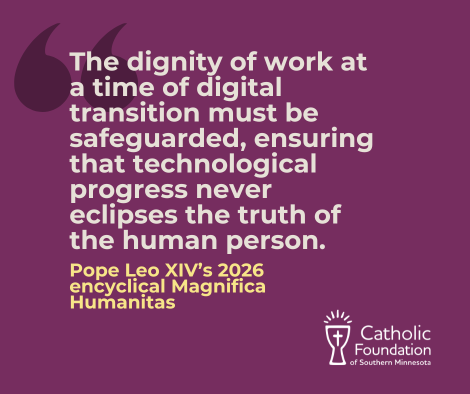
Pope Leo XIV’s 2026 encyclical Magnifica Humanitas speaks directly to this moment. In Chapter Four, titled “The dignity of work at a time of digital transition,” he teaches that “The dignity of work at a time of digital transition must be safeguarded, ensuring that technological progress never eclipses the truth of the human person.” He calls for “an economy that values dignity” in every stage of technological change.
This is not a new teaching. It is a continuation of the Church’s tradition from Pope Leo XIII's Rerum Novarum to Centesimus Annus. But Pope Leo XIV applies it boldly to the age of AI, reminding us that the human person must remain at the center of all economic discernment.
Even if the nature of work changes, our commitment to human dignity should not.
Fear Must Not Our Guide
Rapid change often brings fear: fear of losing work, fear of instability, fear of not knowing what comes next. But Scripture speaks directly to moments like these. Saint Paul writes, “For God did not give us a spirit of cowardice but rather of power and love and self-control.” (2 Timothy 1:7).
Fear is not the Christian response to change. Love is. Community is. Trust in God is.
Whether UBI becomes reality or remains a debated idea, the Church’s call is the same: to walk with one another, to support one another, and to build communities where no one is left behind.
We Belong to One Another
In times of change, it becomes even more important to remember that we are not isolated individuals navigating uncertainty alone. We are the Body of Christ. Paul reminds us, “If [one] part suffers, all the parts suffer with it; if one part is honored, all the parts share its joy.” (1 Corinthians 12:26).
That means:
-
When families face job transitions, we accompany them
-
When young adults navigate a shifting economy, we encourage them
-
When older workers feel displaced, we honor their experience and learn from their wisdom
-
When new technologies reshape industries, we respond with compassion, not panic
The future of work may look different than the past. But the future of Christian community remains the same: we belong to Christ, and we belong to one another.
A Call to Courage and Communion
As conversations about UBI and AI continue, I invite you to reflect on two simple truths:
-
Change is not new. The Church has lived through every economic shift in human history.
-
Christ is constant. His call to love, serve, and build community does not change with technology.
Let us be people who meet change with courage, not fear. People who strengthen community rather than withdraw. People who remember that no matter what the future of work looks like, our mission remains rooted in the Gospel.
We need each other. And together, guided by Christ, we will navigate whatever comes next.
Why this topic? Economic strain on families and workers and the future implications of artificial intelligence was surfaced by interviewees in our 2025 diocesan listening exercise across Southern Minnesota. The Catholic Foundation Board has selected this as one of our strategic priorities in order to support and empower our local communities. Visit our FY27-FY30 strategic plan page to learn more.
Categories
- Artificial Intelligence
- Catholic Ministries Appeal
- Endowments
- Event Management
- Financial News
- Fundraising & Capital Campaigns
- givepage
- Grants
- Immaculate Heart of Mary Seminary
- Ministry Ideas
- News & Press Releases
- Planned Giving
- Stewardship
- Stories of Hope
For many of us, the parish is our spiritual home—a place where faith is nurtured, families gather, individuals find comfort, and communities come together in service. Parishes form disciples, celebrate the sacraments, and foster belonging across generations. To sustain this mission, our communities need resources that support both today’s needs and tomorrow’s opportunities.
To help the Catholic Foundation has created an Endowment Toolkit designed for parishes and other Catholic organizations to create and grow their own endowment, cementing a future revenue stream and instilling confidence in today's donors.
Access the full toolkit online or request a hard copy by contacting us today.
