
 info@catholicfsmn.org
 507-858-1275
Contact Us
 Blog
Blog
 507-858-1275
 info@catholicfsmn.org
Mailing Address:
PO Box 30098750 Terrace Heights, Suite 105 Winona, MN 55987
Originally published in the Diocese of Winona Rochester's August 2026 Courier, Page 14
Earlier this year, I kicked off a series on how we can build long-term financial stability in our Catholic institutions. We began by exploring grants as a revenue stream for Catholic organizations. If you missed that piece, you can find it here.
Today, I’d like to take a look at what parishes and Catholic organizations can learn from the latest charitable giving data. Giving USA’s 2026 annual report shows that charitable giving has increased year over year, but people are giving differently and often with less consistency than in the past.
Diving Into Charitable Giving Studies
After adjusting for inflation, 2025 saw a 1.4% increase in charitable giving from individuals compared to a 16.6% increase in charitable giving from bequests (an individual’s estate) (Source: Giving USA 2026 Report)
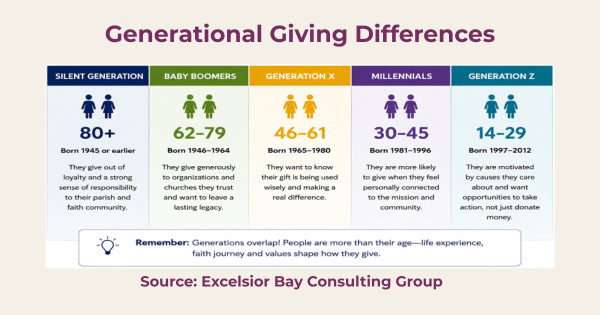
To make sense of these trends, I like to pair high-level giving data with what we know about generational differences in charitable behavior. Of course all of these things are generalizations so don’t be offended if you don’t fit the mold.
- Boomers and the Silent Generation remain the financial backbone of most parishes, giving out of trust, identity, and long‑standing commitment
- The Silent Generation gives because they know they should; The Boomers give to organizations they trust and want to leave a legacy
- Millennials and Gen Z are not less generous. In fact, recent studies show annual giving for Gen Z has increased 16% year over year, compared with Gen X increasing by 12%. However, younger generations give differently. They give with less consistency, and they need real engagement, connection, and transparency.
- In the middle we have Gen X – the quiet and often overlooked generation. They give more annually than Millennials & Gen Z combined but they want to know their gift is being used wisely. They want to see your plan and the positive impact it will have.
- Finally, a surprise in the data tells us that all of these generations give online. Boomers, giving online most often, average 8 times per year of online giving to charity. So, make sure your entire parish is aware of your online giving options.
What does this tell us?
All of this helps us understand annual giving today — but it also points to what may change in the future. Annual giving is critical to your parish or ministry’s success, and there are ways to improve how, when, and where you ask to strengthen results. For ideas, please contact us or find the full article on generational giving differences here: CatholicFSMN.org/Generations.
However, annual giving will change as the older generations pass, and younger generations take their place. In 10 or 20 years, we may not be able to maintain the same level of annual giving as we do today.
The good news? An enormous wealth transfer is underway from our Silent Generation and Boomers, with some studies suggesting as much as $124 Trillion will be transferred in the next 25 years. Consider this: The average individual leaves 14% of their estate to charity.
This shift doesn’t have to be discouraging. In fact, it opens a tremendous opportunity. What if every Catholic in Southern Minnesota left just 5% or 10% of their estate to their parish in an endowment?
A Challenge & Hand Up
We talked about some of the basics of endowments in the June Courier issue. Endowments create sustainable revenue streams that support everything from utilities to capital improvements to staffing.
We challenge every single Catholic parish, school, cemetery, KCs, CCW, etc. in Southern Minnesota to fund an endowment by 2030. It doesn’t have to be large, but it does need to exist, be promoted and be a place that members can trust will help preserve your organization for years to come.
If we want members to consider us in their wills, we need to show them we have a long-term plan for our Catholic parishes and organizations to thrive! An endowment does just that.
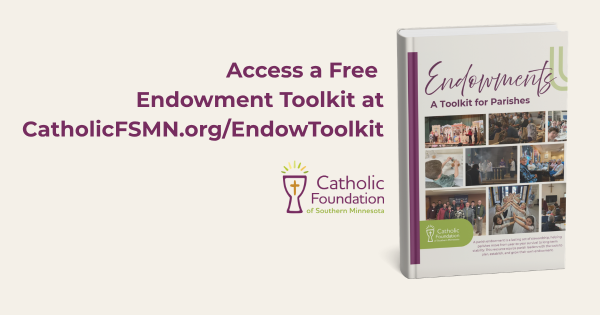
Not sure where to start? Or just have too many other things on your plate to add this? We understand. To do our part in advancing this challenge, we’ll be mailing out a 30+ page endowment toolkit to each parish cluster this fall. The toolkit includes everything from what an endowment is to the technical bookkeeping information you need to know. It includes promotional templates, spending policies, worksheets and more.
Get the endowment toolkit online now: CatholicFSMN.org/EndowToolkit
Why this topic? The long term financial stability of our Catholic organizations was surfaced by interviewees in our 2025 diocesan listening exercise across Southern Minnesota. The Catholic Foundation Board has selected this our top strategic priority through 2030. Visit our FY27-FY30 strategic plan page to learn more.
Categories
- Artificial Intelligence
- Catholic Ministries Appeal
- Endowments
- Event Management
- Financial News
- Fundraising & Capital Campaigns
- givepage
- Grants
- Immaculate Heart of Mary Seminary
- Ministry Ideas
- News & Press Releases
- Planned Giving
- Stewardship
- Stories of Hope
For many of us, the parish is our spiritual home—a place where faith is nurtured, families gather, individuals find comfort, and communities come together in service. Parishes form disciples, celebrate the sacraments, and foster belonging across generations. To sustain this mission, our communities need resources that support both today’s needs and tomorrow’s opportunities.
To help the Catholic Foundation has created an Endowment Toolkit designed for parishes and other Catholic organizations to create and grow their own endowment, cementing a future revenue stream and instilling confidence in today's donors.
Access the full toolkit online or request a hard copy by contacting us today.
