
 info@catholicfsmn.org
 507-858-1275
Contact Us
 Blog
Blog
 507-858-1275
 info@catholicfsmn.org
Mailing Address:
PO Box 30098750 Terrace Heights, Suite 105 Winona, MN 55987
Over the past two evenings, I had the privilege of gathering with parish and cemetery leaders from across the diocese — finance councils, trustees, pastors, and parish staff — for two conversations on stewardship, investing, and long‑term parish health. We were joined by Kim Snyder, a nationally respected philanthropy leader with 30 years of experience and more than two decades advising nonprofits. Her insights helped frame one topic that consistently sparked energy, nods, and honest discussion across both rooms: generational giving differences.
What became clear is this: Catholics of every age are generous — but they give differently. And when parishes understand those differences, they can communicate more effectively, build trust, and strengthen long‑term stewardship.
Key Article Takeaways
-
Catholics of every age are generous — but each generation gives differently, with unique motivations and expectations.
-
National philanthropy expert Kim Snyder emphasized that charitable giving is increasing, not declining: all generations have grown their giving 12–27% since 2021.
-
Younger generations (Millennials & Gen Z) want engagement, transparency, and visible impact before giving; they respond to mission, not maintenance.
-
Gen X is the most overlooked but financially significant group, giving more annually than Millennials and Gen Z combined and valuing clarity, competence, and practical impact.
-
Boomers and the Silent Generation remain the financial backbone of most parishes, giving out of trust, identity, and long‑standing commitment — but many now prefer digital giving.
-
Online giving is now universal across all generations, with Boomers giving online more frequently than younger adults.
-
Parishes strengthen stewardship when they communicate clearly, show impact consistently, and offer multiple giving pathways.
Charitable Giving Is Changing, Not Declining
There is a persistent myth that younger generations are less generous or less committed to the Church. The data tells a different story. Snyder cited several studies (see footnotes), explaining, "Almost $600B was given to charitable causes in 2024. That is an increase of 6.6% in current dollars over 2023, and 3.3% when adjusted for inflation. The majority of the money is and always has been given by individuals -- about 85% (includes 10% from foundations)." What's exciting when we look at generational break downs, is that "All generations have increased their charitable giving since 2021 (average household giving); between 12% and 27%," said Kim. As you might expect, Boomers lead in total dollars.
"However, giving to religious organizations specifically, the single largest philanthropic subsector, has been declining over the years. Religion received 62% of charitable giving in 1984, down to just 34% in 2011," Kim expanded.
The takeaway? Giving patterns are shifting, not shrinking. Each generation brings its own motivations, expectations, and habits.
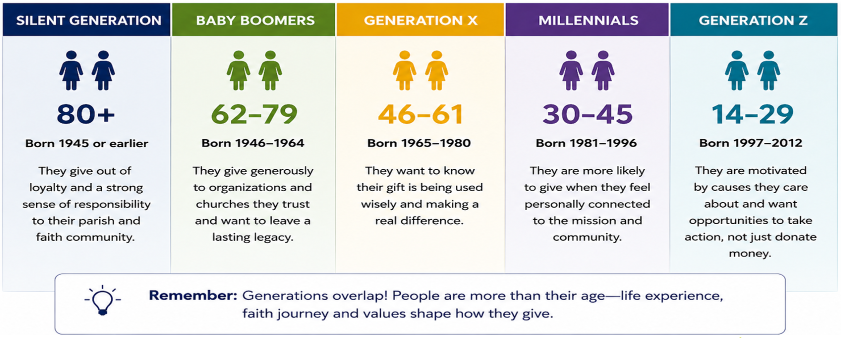
The Church doesn’t need to change its mission, but we do need to adapt how it communicates that mission. Here's a great visual snapshot before I dive into the details:
Younger Generations: Engagement Before Giving
Millennials and Gen Z are not less generous. Actually, recent studies show annual giving for Gen Z's has increased 16% year over year, compared with Gen Xers increasing their annual giving by 12% year over year. However, our younger generations are differently generous. They give less consistently, they give small amounts and most importantly, they want:
- Real engagement & connection
- Transparency
- Clear impact
- Authentic storytelling
They want to understand the “why” behind a request and see the (future) fruit before they sow the seed. They respond to mission, not maintenance; to causes not institutions. When they see lives changed, ministries strengthened, or a parish vision they can believe in, they give — and they give meaningfully.
"They want to change the world," explained our philanthropy consultant, Kim Snyder in this week's presentation at Our Lady of Good Counsel in Wilmont, MN. We must see this as a wonderful invitation! It pushes parishes to communicate more clearly, share outcomes more consistently, and invite people into the mission before asking for support.
Gen X: Quiet, Untapped Potential
One of the most overlooked groups in parish stewardship is Generation X — adults roughly ages 44–59. Research consistently shows that Gen X gives more annually than Millennials and Gen Z combined, yet they are rarely the focus of parish communication strategies. Often because we also know that our Baby Boomers are the largest givers in our parishes. But remember, our Gen X's are the future largest givers and they think and give differently than previous generations too.
Gen X donors value:
- Stability
- Competence
- Practical and real impact
- Low‑drama, high‑trust leadership
Bottomline, they want to know their gift will be used wisely to make a difference. Gen X's respond strongly to:
- “Show me the plan.”
- “Show me the numbers.”
- “Show me the impact.”
Many are finishing raising children, supporting aging parents, and carrying the financial weight of two generations. When they give, it is because the mission feels worth the stretch. Parishes that communicate clearly, professionally, and consistently often see Gen X giving increase. They are also the most digitally consistent generation, giving online frequently and reliably so don't forget to give them the online option too.
Older Generations: Consistency, Trust, and Relationship
Baby Boomers and the Silent Generation remain the financial foundation of most parishes. Their giving is rooted in:
- Habit
- Identity
- Trust in parish leadership
- A lifelong commitment to the Church
Kim Snyder explained, "The Silent generation gives because they know they are supposed to and they believe in institutions, whereas Baby Boomers are thinking of their legacy and want to ensure they invest somewhere they can trust."
But even here, habits are shifting. Many older donors now prefer digital giving, appreciate clear communication about parish needs, and respond well to updates that show how their generosity is making a difference.
The Surprise: Online Giving Is Now Universal
One of the most eye‑opening data points from our seminars is that online giving is active across all generations today. Interestingly, Boomers on average give online to charity more than 8 times per year, but "they will first visit your website, check out the organization and the gifting process to ensure they feel safe before giving online," Kim explained further. This is more frequent online giving than younger adults!
This reinforces a simple truth: Online giving is no longer a “young person’s tool.” It is a stewardship tool for everyone.
How to help your parish give: Parishes that offer multiple giving pathways — digital, in‑person, recurring, and project‑based — meet donors where they are, not where we assume them to be.
What This Means for Parish Stewardship
No single message works for all generations. A healthy stewardship strategy must be:
- Multi‑channel
- Multi‑message
- Transparent
- Mission‑driven
- Outcome‑oriented
- Relational
Younger donors want impact and engagement.
Gen X wants clarity and competence.
Older donors want trust and consistency.
When parishes communicate in ways that honor each group, giving becomes stronger across the entire community.
Practical Steps Parishes Can Take Now
Here are simple actions any parish can begin this month:
- Show impact visually and consistently. Photos, stories, and updates matter.
- Share stories of lives changed. People give to mission, not maintenance.
- Use digital tools for all generations. Don’t assume who will or won’t use them. (If you need help here, reach out to us today)
- Communicate needs clearly and confidently. Ambiguity hinders generosity.
- Invite engagement before asking for gifts. Discipleship precedes generosity.
These steps don’t require new staff or new systems. Just intentionality.
A Hopeful Future for Parish Giving
The most encouraging takeaway from both seminars is this: generosity is alive and well in our parishes. People want to give. They want to be a part of the mission. They want to see their parish thrive.
When we understand how different generations give — and why — we can communicate more effectively, build deeper trust, and strengthen the Church for decades to come.
If you’d like help reviewing your parish’s stewardship approach or building a communication plan that speaks to all generations, I’m always glad to assist at ewilliams@catholicfsmn.org.
Article sources:
Kim Snyder, Excelsior Bay Group
Candid, Shifts in Aging Across Generations (May 6, 2025)
Lily Family School of Philanthropy, Next Generation of Philanthropy (January 2025)
Giving USA Special Report: Generations and Giving (2025)
Questions this Article Answers
1. Are younger generations really giving less to the Church?
No. Younger adults are giving differently, not less. Studies show Gen Z’s annual giving increased their charitable giving 16% year over year, and Millennials continue to grow in generosity. So, if their not giving to the Church with those charitable dollars, know they simply want engagement, transparency, and clear impact before they give.
2. Why is Gen X so important for parish stewardship?
Gen X (ages ~44–59) gives more annually than Millennials and Gen Z combined, yet they are rarely targeted in parish communication. They value stability, competence, and practical results — and they respond strongly when parishes communicate clearly and professionally.
3. Are Boomers still the primary financial supporters of parishes?
Yes. Boomers remain the largest givers in total dollars, and the Silent Generation continues to give out of lifelong commitment and trust. However, both groups increasingly prefer digital giving and appreciate regular updates on how their gifts make a difference.
4. Is online giving mainly for younger parishioners?
Not anymore. Online giving is now universal. Boomers give online more than eight times per year on average, often more frequently than younger adults. They simply want to feel confident that the parish website and giving process are secure.
5. What’s the biggest mistake parishes make when communicating about stewardship?
Using one message for all generations. Younger donors want impact and engagement, Gen X wants clarity and competence, and older donors want trust and consistency. A multi‑channel, multi‑message approach is essential.
6. What simple steps can a parish take this month to strengthen giving?
Show impact visually, share stories of lives changed, offer digital giving options for all ages, communicate needs clearly, and invite engagement before asking for support. These steps require intentionality, not new staff or new systems.
Why this topic? The long-term financial stability of our Catholic organizations was surfaced by interviewees in our 2025 diocesan listening exercise across Southern Minnesota. The Catholic Foundation Board has selected this our top strategic priority through 2030. Visit our FY27-FY30 strategic plan page to learn more.
Categories
- Artificial Intelligence
- Catholic Ministries Appeal
- Endowments
- Event Management
- Financial News
- Fundraising & Capital Campaigns
- givepage
- Grants
- Immaculate Heart of Mary Seminary
- Ministry Ideas
- News & Press Releases
- Planned Giving
- Stewardship
- Stories of Hope
For many of us, the parish is our spiritual home—a place where faith is nurtured, families gather, individuals find comfort, and communities come together in service. Parishes form disciples, celebrate the sacraments, and foster belonging across generations. To sustain this mission, our communities need resources that support both today’s needs and tomorrow’s opportunities.
To help the Catholic Foundation has created an Endowment Toolkit designed for parishes and other Catholic organizations to create and grow their own endowment, cementing a future revenue stream and instilling confidence in today's donors.
Access the full toolkit online or request a hard copy by contacting us today.
